 by
by The problem: the unmanageable complexity of management software
When we discuss planning maintenance for large vehicle fleets, the industry often faces a critical challenge regarding operational readiness and resource allocation. While predictive maintenance (PdM)—which utilizes sensor data and condition monitoring equipment to predict failures—can yield significant savings, it requires a substantial initial investment and fine-tuned hardware integration. Because of these high entry barriers, many organizations continue to rely on Computerized Maintenance Management Systems (CMMS) to handle their periodic maintenance schedules.
However, empirical research consistently shows that these systems suffer from remarkably low adoption rates. This failure is driven by two primary factors: insufficient information technology infrastructure within the organization and significant, systemic usability issues. Most current CMMS tools fail to optimize their schedules automatically, forcing companies to resort to complex, custom-coded implementations just to achieve functional results. Furthermore, these platforms are often overwhelming to navigate due to convoluted, non-intuitive interfaces and repetitive manual procedures that drain operator time. If strict constraints exist—such as limited maintenance facility capacity—inefficient scheduling becomes a massive logistical bottleneck. These limitations lead to a critical failure in trust: either the organization suffers from underutilized assets (by performing maintenance too early) or they face dangerous operational delays (by postponing tasks beyond safe limits).
What do we propose in this work?
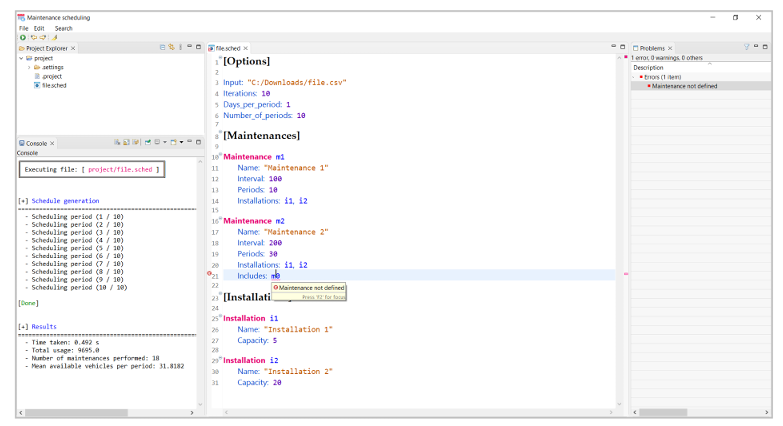
To bridge the dangerous gap between mathematical optimization and human user experience, we published research introducing a Domain-Specific Language (DSL) designed strictly according to Model-Driven Engineering (MDE) principles. This approach drastically simplifies the maintenance scheduling process by replacing complex, multi-layered graphical forms with a concise, textual specification that is both readable and auditable. In short, our system addresses three core properties of trustworthy algorithmic systems, transforming them from abstract regulatory goals into operational engineering specifications.
- Efficiency: In our framework, efficiency is not merely a performance metric; it is a foundational operational requirement that ensures algorithmic viability. Our DSL utilizes a powerful Monte Carlo Tree Search (MCTS) algorithm to maximize vehicle usage while minimizing the total number of required maintenances. More importantly, it drastically reduces the “computational friction” of the human operator—our empirical usability tests show that the DSL significantly outperforms industry-standard CMMS tools (such as UpKeep, MaintainX, and IBM Maximo) by reducing task completion time, minimizing mouse movement, and lowering the number of required keystrokes. This proves that an algorithm is only as efficient as the human-machine loop it inhabits.
- Robustness: A trustworthy algorithm must maintain stable performance under varied, noisy, or unforeseen production conditions. Our system demonstrates this property by natively handling complex operational restrictions—such as installation capacity limits and maintenance interval dependencies—that standard CMMS tools are mathematically unable to enforce. By formalizing these constraints within the DSL architecture, we ensure that the generated schedules remain accurate, reproducible, and valid, even when the fleet faces high-throughput production demands that would otherwise cause traditional systems to produce volatile or unpredictable output.
- Accessibility: Trustworthy systems must be structurally designed to prevent the exclusion of users, ensuring that their input channels and transparency outputs remain reachable for all, regardless of technical background. We have operationalized accessibility by creating a textual, human-readable DSL that effectively abstracts the underlying complexity of MCTS optimization. This ensures that domain experts—not just specialized programmers—can independently define and audit their specific maintenance requirements. By lowering the threshold for participation, we prevent the systemic exclusion of domain knowledge from the decision-making loop, which is a frequent cause of failure in high-stakes environments.
The connection to trustworthy algorithms
This work demonstrates that an algorithm’s trustworthiness is measured by how well it integrates into real-world production environments, rather than how it performs on sterile laboratory datasets. True technological efficiency, robust adherence to operational constraints, and inclusive access to algorithmic control are not peripheral conveniences; they are the structural pillars that justify our calibrated reliance on these systems.
Advanced optimization algorithms often require deep programming knowledge to be adapted to specific situations, which creates a “sociotechnical trap” where the model remains an unauditable black box to the very operators who must trust it. By encapsulating algorithmic complexity within a highly usable, human-centered Integrated Development Environment (IDE) that provides real-time feedback and transparent visual reports, we ensure that operators fully understand and control the generated schedules. We demonstrate that for an algorithm to be truly worthy of trust, it must be engineered from the ground up to be structurally, interactionally, and socially accountable under real-world duress.
Read the full research
If you want to dive deeper into the metamodel design, the specific Bézier curves used for probability distributions, or the detailed results of the user effort metrics (including clicks, mouse-wheel use, and subjective usability ratings), the full article has been published in Science of Computer Programming.
👉 Read the full paper here (DOI: 10.1016/j.scico.2026.103533)
